


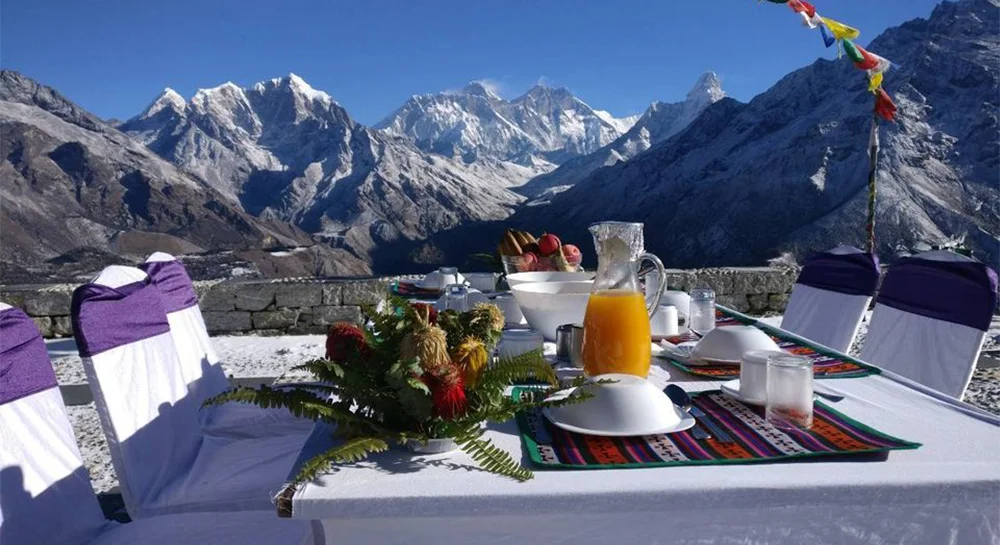


The Everest base camp trek is certainly the most coveted route for trekking enthusiasts. Every year, thousands of hikers land at Lukla airport, which Sir Edmund Hillary built in 1964, and travel through the Khumbu valley to the very site of the first feat, eager to realize their dream too. As you head deeper into the Khumbu valley, the colossal giants; Everest, Lhotse, Cho Oyu, Pumori, Ama Dablam, Khumbila, Thamserku, Kantenga and others, reveal themselves, as if, telling us how futile our worldly pleasures and pain are.
Our EBC trek program begins with an exploration of the cultural troves in Kathmandu, followed by a scenic flight to Lukla. You will then gradually hike through the villages in the upper Khumbu, to the heart of the Sherpa villages at Namche. The rest day at Namche offers a brilliant excursion to a vantage point for a sunrise view and the first glimpse of Everest. Over the next days, you will follow the Dudh Koshi river and then the Imja river till Dingboche, and follow the Khumbu basin on glacially eroded and windswept valleys to Gorak Shep. The next day, you embark on the highlight of the trek; the early morning hike to Kala Patthar (5,643 m), where an incredible panorama of the “Roof of the World” and the most beautiful mountains on Earth await you. You will then retrace your steps till Lobuche, take a detour via Pheriche, Phortse and Khumjung to Namche, and backtrack to Lukla.
The mountains and the views are definitely the highlights of the Everest Base Camp Trek, but the culture, food and hospitality of the legendary Sherpas can’t be dismissed. Along the trail, you will stay in family-run lodges, and hopefully, get a better understanding of their ties to the mountains. The Sherpas are the true heroes of the mountains, for without them guided expeditions to the Himalayas giants wouldn’t be possible.
Keep Walking Nepal is pleased to invite you on our 18 day EBC trek as part of our extended family. We have been running trips in the region for more than 15 years and know the terrain like the back of our hands. For extreme adventure enthusiasts, we also offer the challenging 23-day Everest Three Passes Trek.
Our representative will pick you up at Kathmandu International Airport and drive you to your hotel. Depending upon what time you arrive, you can enjoy a full day at leisure. In the evening, we will meet for a welcome dinner with Keep Walking Nepal family.
Look out for the KEEP WALKING NEPAL board behind the railing once you exit the airport terminal.
Look out for the KEEP WALKING NEPAL board behind the railing once you exit the airport terminal.
You will embark on a guided tour of two UNESCO world heritage sites; Pashupatinath Temple, the temple devoted to Lord Shiva – the god of creation and destruction, and Boudhanath Stupa – a Buddhist shrine worshipped by Hindus & Buddhists alike.
In the afternoon, your trek guide will brief you about the upcoming days and preparation requirements.
You will drive to Kathmandu Domestic airport for an adventurous early morning 40m flight to Lukla’s Tenzing Hillary Airport (2,800m). The flight is an adventure in itself. In clear weather, one is rewarded with the first glimpse of Everest.
At Lukla, you meet the rest of your crew. The porters will take your duffel bag and will meet you at the lodge (this will continue throughout the trek).
Once out of Lukla, you will descend past small fields and cozy little wooden houses with vegetable gardens; all with a picturesque mountain backdrop. Along the way, you might encounter some pack animals as they are the only means of goods transportation up and down the mountain.
Along the way, in clear weather, one can catch views of the ice-covered 6000m high Kusum Kanguru. The trail is marked by impressive black mani stones painted with Tibetan inscriptions and a large stupa which indicates our destination for the day, Phakding, is nearby.
After breakfast, you will continue on the trail. It is a relatively short day as you cross suspension bridges over raging streams, past small hamlets and fields. Though the trail isn’t difficult, it is undulating – what we call the Nepali flat.
You will reach Monjo for lunch and the rest of the day is at leisure. You can visit the local school, visit the local snooker house for some beer or just call it a day.
Shortly after Monjo, you will arrive at the entrance of Sagarmatha National Park, a UNESCO World Heritage Site. The hike is beautiful with beautiful pine forests, raging rivers, and mountains in the backdrop. Another hour and we cross the milky river (Dudh Koshi) – over an iconic suspension bridge hanging a 100m above the river bed.
Once across the bridge, you will definitely feel the mountain as you climb the steep uphill to Namche. The trail is frequented by porters carrying humongous loads and trains of pack animals. In clear weather, Everest is also visible.
After the 600m vertical ascent in about 4 – 5 hours, you will arrive at Namche, the Sherpa capital of Khumbu.
An important rule for a successful trek is successful acclimatization. Following the mantra, you will spend a second night in Namche but visit higher grounds to adapt our body.
We suggest an hike early morning hike to the Everest View Hotel (3,880m) and enjoy a breathtaking 360 panorama of Everest, Taboche, Thamserku, Kongde Ri and Ama Dablam.
Leaving behind the bustling town of Namche, you will head east high above the raging Dudh Koshi river.
You will climb over open slopes, a few houses and sparse pine forest and then descend to the river again at Phunki Tenga to cross the Imja Khola. The trail now sharply ascends through mixed pine and juniper forest to Tengboche.
Tengboche monastery, largest in Khumbu, was completely destroyed by fire some decades ago but has been completely restored thanks to donations, especially from abroad. The double top view of Kongde Ri with the monastery in the front is picture-perfect. The monastery houses art, a large Buddha statue and musical instruments and robes of the Lama.
After a short rest, you will descend through Himalayan Birch, pine & juniper forest to the Deboche, your stop for the night.
After breakfast, you will continue on the trail along the Imja Khola and cross a suspension bridge to a breathtaking view of Ama Dablam’s twin towers.
You will continue to ascend towards Pangboche past mani stones inscribed with mantras. The village monastery is said to have the skull and legs/hand of a yeti but has been recently stolen so that they are unfortunately no longer visible. However, the monastery is quite worthwhile. Ama Dablam, Thamserku, Lhotse, Nuptse, Lobuche Peak, Pumori, and many other giants give one the justified feeling of walking among the highest peaks in the world.
As you ascend the change in vegetation is dramatic. You will continue up to the traditional Sherpa village of Dingboche (4350 m). The village is one of the highest permanently inhabited places in the world. The stone houses are spread far apart between the fields. Along the way, we walk along one of the most famous peaks of the Himalayas: the Ama Dablam, so famous for its peculiarly tilted shape.
We spend another night at Dingboche for better acclimatization. To better adapt our bodies we follow the old mantra of hiking up to a higher altitude and sleeping at a lower one.
Nagarjuna hill in the south of Dingboche at about 5100m has brilliant views of Lobuche, Island Peak, and Ama Dablam. We return back to Dingboche for an afternoon of rest.
Today, you will trek through alpine meadows and summer yak pastures alongside the Khumbu glacier moraine to Lobuche.
In the beginning, for an hour or so, the trail gradually ascends and then undulates till the wooden bridge crossing over the Imja river. Just across the river is Thugla, a steep ridge. After lunch amid views of Ama Dablam to the east and Cholatse and Toboche to the west, you will ascend about 200m to the hilltop which opens up to a plateau marked with stone cairns, memorials to those who lost their lives while climbing Everest.
From the memorial onwards, you will hike with the Khumbu glacier to the left, just across a deep trench, all the way to Lobuche. All the way, Nuptse (7,861m) gleams beautifully above the glacier to the east.
After an early morning breakfast, you will start towards the coveted EBC.
After about an hour’s hike through gently sloping alpine meadows, the trail passes through a moraine following the rugged contour of the Khumbu glacier, past a rocky rim, to Gorak Shep, a small valley where Pumori and Nuptse dominate the view throughout.
Post lunch, you will follow the moraine trail to Everest Base Camp. The trail is tricky with loose rocks and boulders and takes about 3 hours to and fro. If time and fitness permits, you can hike to Kalapathar (5,643m and 3 hours to and fro from Gorak Shep) for a sunset view over Everest, Nuptse and Lhotse.
If you couldn’t make it to Kala Pathar on the previous day, you can still visit it today.
You will start early to catch the sun come over the magnificent backdrop of Everest and the surrounding peaks. After breakfast at Gorak Shep, you will backtrack to Pheriche across the Khumbu Khola.
Leaving Pheriche, you will cross over the Khumbu River to a junction with the outbound trail below Dingboche. The trail eventually meets at Pangboche, but you will hike to Upper Pangboche and then walk through one of the most spectacular trails in all of the Everest region. It is the high trail to the less often visited village of Phortse (3800m) which is home to many Everest climbers.
The trail follows the side of the hill and climbs up and down often making steep ascents and descents on stone staircases some of which are quite steep. As you skirt the hill you can see the lodges of Deboche which you had passed a fews days ago. This trail has brilliant views of Ama Dablam, Melangphulang, Kangtega, and Thamserku and to the north Everest and Lhotse as well.
The trail finally climbs to a small chorten from where the village of Phortse lies below. Keep an eye out as you pass through terraced fields that are home to a brightly colored pheasant, the Daphne Pheasant, the national bird of Nepal.
Phortse village is a maze of small walled lanes. It is one of the oldest villages in the Khumbu region. You can visit the Phortse Gompa at the top of the village.
Initially, you follow the trail that drops sharply to the banks of the Dudh Koshi river. On the other side is the small settlement of Phungi Thenga. The trail then ascends to Mong La (4,000 m). The trail is frequented by trekkers either going to or returning from Gokyo.
After a scrumptious lunch at Mong la, with excellent views of Aama Dablam, Thamserku, Kusum Khangkaru, Kongde Ri and Tawache peak to keep you company, you will descend to Khumjung village, the largest settlement in the Khumbu region.
The only high school founded by Sir Edmund Hillary in 1961 is definitely worth a visit. Also, don’t miss the mysterious Khumjung monastery where a Yeti scalp and skull are said to be “preserved”.
It’s all down hill from here. You will hike directly down to Namche and after some rest retrace your steps back to Monjo.
The decrease in elevation from Khumjung to Monjo is almost 1,000m, but it isn’t all descends. Just out of Namche, you will have the famed “Nepali Flats” all to yourself till Benkar. You shouldn’t rush as it can be hard on the knees; we suggest you pace yourself and don’t be intimated by the scampering footsteps of children’s and grannies.
Backtracking to Lukla on the famous ‘Nepali Flats’, your journey in the homeland of the Sherpas will have come to an end. Alas, its your last day with your crew of Sherpas and porters, and rightfully calls for a celebration.
Bidding farewell to your crew, you will fly back to Kathmandu, where Keep Walking Nepal’s diligent staff will be waiting for you.
The rest of the day is at leisure. We recommend a quick shower and a visit to the laundromat.
You have the whole day at leisure to explore Kathmandu valley. This extra day also ensures a contingency plan, in case flights out of Lukla are hampered due to inclement weather.
In the evening there will be a farewell dinner by Keep Walking Nepal to celebrate your achievements.
A KWN representative will accompany you to the Tribhuwan International Airport for your flight back home.
| Start | Finish | Availability | Price | |
|---|---|---|---|---|
| Thursday 05/03/2026 | Monday 23/03/2026 | Trip Status available | Starting from $2440 | Book Now |
| Thursday 12/03/2026 | Monday 30/03/2026 | Trip Status available | Starting from $2440 | Book Now |
| Thursday 19/03/2026 | Monday 06/04/2026 | Trip Status available | Starting from $2440 | Book Now |
| Friday 27/03/2026 | Tuesday 14/04/2026 | Trip Status available | Starting from $2440 | Book Now |
| Wednesday 01/04/2026 | Sunday 19/04/2026 | Trip Status available | Starting from $2440 | Book Now |
| Tuesday 14/04/2026 | Saturday 02/05/2026 | Trip Status available | Starting from $2440 | Book Now |
| Tuesday 21/04/2026 | saturday 09/05/2026 | Trip Status available | Starting from $2440 | Book Now |
| Sunday 04/10/2026 | Thursday 22/10/2026 | Trip Status available | Starting from $2440 | Book Now |
| Sunday 10/10/2026 | Wednesday 28/10/2026 | Trip Status available | Starting from $2440 | Book Now |
| Thursday 29/10/2026 | Monday 16/11/2026 | Trip Status available | Starting from $2440 | Book Now |
| Friday 06/11/2026 | Tuesday 24/11/2026 | Trip Status available | Starting from $2440 | Book Now |
| Sunday 19/12/2026 | Wednesday 06/01/2027 | Trip Status available | Starting from $2440 | Book Now |
Here is a list of what you might want to pack for the hike. Please take this as a starting point. You’ll need layers of warmer clothing during the winter. We provide a 75 liter duffel bag for you to use for the trek. It will be given to you during your pre-trip meeting in Kathmandu. The duffle bag is yours to keep. Also, you can rent sleeping bag and down jacket with us at the additional fee of USD 35 for each once you are in Kathmandu.

Enter a recent customer’s contact info and we’ll ask them to leave you a review.
In April 2023, over 13 fantastic days, my two 15 year old sons and I (49 years old, mum) trekked from Lukla to Everest Base Camp with Keep Walking Nepal. This was our first holiday in Nepal. It was an
We had the most marvellous time with our guide Pratap venturing to EBC and back! We were well looked after and went at a great pace. We thoroughly enjoyed the hilarious banter with Pratap and the wisd
I did the Everest Base Camp Trek in November 2015 (the earliest trip advisor will let me go back is November 2017). This was a highly organized, safe and very enjoyable experience. My guide, Pratap, w
Spent time with Ang hiking through the Kumbhu Valley. Highly rate his service and experience. Already planning the next trip back to see him!
it was the best experience I’ve ever had . id like to thank Mr.Pratap who was our main guid for this trek. he is a really nice person and took care of me as well as my group , he was patient and had
It was very exciting moment with your team “Keep Walking Nepal”.
I have travelled twice With Keep Walking Nepal, and I have no doubt in recommanding these guys. My first KWN-trek was a trek from Phaplu to the Junbesi area. Our KWN-guide was like an eagle to monitor
Keep Walking Nepal provided an excellent guiding experience allowing our team of 3 to safely and affordably complete the three passes over 20 days. I can’t recommend these guys enough.
Trekking to Base Camp when you are 60 and you only like hiking sort day hikes was something I never thought I’d do but it was on my husband’s bucket list. We decided to make it a family affair. Th

We went with KWN for a 3-week trip to the 3 passes and Everest Base Camp in October 2017. To sum it up, we had an absolutely fantastic experience. Their organisation was flawless throughout – e.g. f
We had a wonderful time; they were extremely helpful and very well organised. Big thanks to Ang, Chopel and Mr Yum Yum
I did the Everest Circuit trek (Gokyo Lakes – Chola Pass – Kala Pittar / Everest Base Camp) with Ang Tshering Sherpa as my guide. It was my first trip overseas and one that I had been itching to d
We had a awesome trip, Pratap Gurung was our guide from Keep Walking and he was a fantastic guide super chilled out but always helpful and full of local knowledge. We did a hike up to Gokyo Ri and the
With extensive local knowledge and friendly, helpful service, I cannot recommend Keep Walking enough. They guided myself and my partner on both my first and second trip to Nepal, vesting Lang Tang Val
Keep Walking Nepal was highly recommended to me by a friend who went on a trek with the owner years ago, and I am so glad that we chose them as our trekking agency. The owner and staff are friendly, h
I would give 6 stars if I could. This trip was unbelievably fantastic, everything about it. WOW, WOW, WOW. A trip beyond expectations. The scenery, people, villages, culture, food – all totally capt
I am one of 8 Australian women who booked Ama Dablam base camp hike in mid 2017 and just completed the hike in early May 2018. I actually heard about Ang’s family many years ago from Keep Walking SA
From initial email contact prior to the trip, right through to ensuring that we had the best rooms available, our recent experience with Keep Walking Nepal was perfect from start to finish. Being 65+
The best trip I have done in Nepal. This journey had it all from jaw dropping scenery to amazing destinations. KEEP WALKING NEPAL organised a fantastic itinerary that suited all our needs. We were a m
I and my friend Jill signed up with Keep Walking Nepal to trek the Langtang Valley to the village of Langtang. It was an amazing experience. We had a guide Pratap who was very knowledgeable and always
Recently returned from a fantastic trek along the Everest Base Camp trail as far as Deboche, arranged by Ang Tshering Sherpa and Keep Walking Nepal. From the initial greeting at KTM airport through to
My nephew and I recently completed a one-week trek along the Everest Base Camp trail arranged by Keep Walking Nepal, and we couldn’t be more happy with our choice of trekking agency. As we only had
Keep Walking Nepal describes itself as a family business. It is.This is KWN’s strength. My daughter Bonnie and I had randomly chosen KWN for our 15 day Everest Region trek. At first, we had some dou
I trekked with Ang and team in the Everest Region and had the most amazing journey. (It was several years before March 2017, but that was the choice provided in the menu) We saw the beautiful sights a
Most incredible adventure with the most amazing guide Pratap Gurung and Som our porter. We spent 2 weeks trekking Gokyo lakes and it was everything i ever imagined it would be and more. This was thank
Trek with ang is always the best Had a wonderful time Thank you for your hospitality I will again visit Nepal ang
An absolutely amazing experience trekking through Nepal and made effortless through the exceptional organising of Keep Walking Nepal! Our Sherpa was extremely experienced and provided us with an amazi
This trip was the best one I had so far thanked you so much for your kind hospitality loved the trek Keep going until next time.
Another great trip with this company, Ang always delivers for us, and we are never disappointed. Gokyo lakes is a great location to trek to, we have done it twice last time in 2010. Thank you to Ang a
Keep Walking Nepal describes itself as a family business. It is.This is KWN’s strength. My daughter Bonnie and I had randomly chosen KWN for our 15 day Everest Region trek. At first, we had some dou
In April 2023, over 13 fantastic days, my two 15 year old sons and I (49 years old, mum) trekked from Lukla to Everest Base Camp with Keep Walking Nepal. This was our first holiday in Nepal. It was an
We had the most marvellous time with our guide Pratap venturing to EBC and back! We were well looked after and went at a great pace. We thoroughly enjoyed the hilarious banter with Pratap and the wisd
I did the Everest Base Camp Trek in November 2015 (the earliest trip advisor will let me go back is November 2017). This was a highly organized, safe and very enjoyable experience. My guide, Pratap, w
Spent time with Ang hiking through the Kumbhu Valley. Highly rate his service and experience. Already planning the next trip back to see him!
it was the best experience I’ve ever had . id like to thank Mr.Pratap who was our main guid for this trek. he is a really nice person and took care of me as well as my group , he was patient and had
It was very exciting moment with your team “Keep Walking Nepal”.
I have travelled twice With Keep Walking Nepal, and I have no doubt in recommanding these guys. My first KWN-trek was a trek from Phaplu to the Junbesi area. Our KWN-guide was like an eagle to monitor
Keep Walking Nepal provided an excellent guiding experience allowing our team of 3 to safely and affordably complete the three passes over 20 days. I can’t recommend these guys enough.
Trekking to Base Camp when you are 60 and you only like hiking sort day hikes was something I never thought I’d do but it was on my husband’s bucket list. We decided to make it a family affair. Th
We went with KWN for a 3-week trip to the 3 passes and Everest Base Camp in October 2017. To sum it up, we had an absolutely fantastic experience. Their organisation was flawless throughout – e.g. f
We had a wonderful time; they were extremely helpful and very well organised. Big thanks to Ang, Chopel and Mr Yum Yum
I did the Everest Circuit trek (Gokyo Lakes – Chola Pass – Kala Pittar / Everest Base Camp) with Ang Tshering Sherpa as my guide. It was my first trip overseas and one that I had been itching to d
We had a awesome trip, Pratap Gurung was our guide from Keep Walking and he was a fantastic guide super chilled out but always helpful and full of local knowledge. We did a hike up to Gokyo Ri and the
With extensive local knowledge and friendly, helpful service, I cannot recommend Keep Walking enough. They guided myself and my partner on both my first and second trip to Nepal, vesting Lang Tang Val
Keep Walking Nepal was highly recommended to me by a friend who went on a trek with the owner years ago, and I am so glad that we chose them as our trekking agency. The owner and staff are friendly, h
I would give 6 stars if I could. This trip was unbelievably fantastic, everything about it. WOW, WOW, WOW. A trip beyond expectations. The scenery, people, villages, culture, food – all totally capt
I am one of 8 Australian women who booked Ama Dablam base camp hike in mid 2017 and just completed the hike in early May 2018. I actually heard about Ang’s family many years ago from Keep Walking SA
From initial email contact prior to the trip, right through to ensuring that we had the best rooms available, our recent experience with Keep Walking Nepal was perfect from start to finish. Being 65+
The best trip I have done in Nepal. This journey had it all from jaw dropping scenery to amazing destinations. KEEP WALKING NEPAL organised a fantastic itinerary that suited all our needs. We were a m
I and my friend Jill signed up with Keep Walking Nepal to trek the Langtang Valley to the village of Langtang. It was an amazing experience. We had a guide Pratap who was very knowledgeable and always
Recently returned from a fantastic trek along the Everest Base Camp trail as far as Deboche, arranged by Ang Tshering Sherpa and Keep Walking Nepal. From the initial greeting at KTM airport through to
My nephew and I recently completed a one-week trek along the Everest Base Camp trail arranged by Keep Walking Nepal, and we couldn’t be more happy with our choice of trekking agency. As we only had
We have not long returned from a trek to Lo Mantang with Keep Walking Nepal. It wasn’t our first trip with Ang’s team & we never hesitate to use them for a special experience trekking. Our gui
Keep Walking Nepal describes itself as a family business. It is.This is KWN’s strength. My daughter Bonnie and I had randomly chosen KWN for our 15 day Everest Region trek. At first, we had some dou
I trekked with Ang and team in the Everest Region and had the most amazing journey. (It was several years before March 2017, but that was the choice provided in the menu) We saw the beautiful sights a
Most incredible adventure with the most amazing guide Pratap Gurung and Som our porter. We spent 2 weeks trekking Gokyo lakes and it was everything i ever imagined it would be and more. This was thank
Trek with ang is always the best Had a wonderful time Thank you for your hospitality I will again visit Nepal ang
An absolutely amazing experience trekking through Nepal and made effortless through the exceptional organising of Keep Walking Nepal! Our Sherpa was extremely experienced and provided us with an amazi
This trip was the best one I had so far thanked you so much for your kind hospitality loved the trek Keep going until next time.
Another great trip with this company, Ang always delivers for us, and we are never disappointed. Gokyo lakes is a great location to trek to, we have done it twice last time in 2010. Thank you to Ang a
Keep Walking Nepal describes itself as a family business. It is.This is KWN’s strength. My daughter Bonnie and I had randomly chosen KWN for our 15 day Everest Region trek. At first, we had some dou
In April 2023, over 13 fantastic days, my two 15 year old sons and I (49 years old, mum) trekked from Lukla to Everest Base Camp with Keep Walking Nepal. This was our first holiday in Nepal. It was an
We had the most marvellous time with our guide Pratap venturing to EBC and back! We were well looked after and went at a great pace. We thoroughly enjoyed the hilarious banter with Pratap and the wisd
I did the Everest Base Camp Trek in November 2015 (the earliest trip advisor will let me go back is November 2017). This was a highly organized, safe and very enjoyable experience. My guide, Pratap, w
Spent time with Ang hiking through the Kumbhu Valley. Highly rate his service and experience. Already planning the next trip back to see him!
it was the best experience I’ve ever had . id like to thank Mr.Pratap who was our main guid for this trek. he is a really nice person and took care of me as well as my group , he was patient and had
It was very exciting moment with your team “Keep Walking Nepal”.
I have travelled twice With Keep Walking Nepal, and I have no doubt in recommanding these guys. My first KWN-trek was a trek from Phaplu to the Junbesi area. Our KWN-guide was like an eagle to monitor
Keep Walking Nepal provided an excellent guiding experience allowing our team of 3 to safely and affordably complete the three passes over 20 days. I can’t recommend these guys enough.
Trekking to Base Camp when you are 60 and you only like hiking sort day hikes was something I never thought I’d do but it was on my husband’s bucket list. We decided to make it a family affair. Th
We went with KWN for a 3-week trip to the 3 passes and Everest Base Camp in October 2017. To sum it up, we had an absolutely fantastic experience. Their organisation was flawless throughout – e.g. f
We had a wonderful time; they were extremely helpful and very well organised. Big thanks to Ang, Chopel and Mr Yum Yum
I did the Everest Circuit trek (Gokyo Lakes – Chola Pass – Kala Pittar / Everest Base Camp) with Ang Tshering Sherpa as my guide. It was my first trip overseas and one that I had been itching to d
We had a awesome trip, Pratap Gurung was our guide from Keep Walking and he was a fantastic guide super chilled out but always helpful and full of local knowledge. We did a hike up to Gokyo Ri and the
With extensive local knowledge and friendly, helpful service, I cannot recommend Keep Walking enough. They guided myself and my partner on both my first and second trip to Nepal, vesting Lang Tang Val
Keep Walking Nepal was highly recommended to me by a friend who went on a trek with the owner years ago, and I am so glad that we chose them as our trekking agency. The owner and staff are friendly, h
I would give 6 stars if I could. This trip was unbelievably fantastic, everything about it. WOW, WOW, WOW. A trip beyond expectations. The scenery, people, villages, culture, food – all totally capt
I am one of 8 Australian women who booked Ama Dablam base camp hike in mid 2017 and just completed the hike in early May 2018. I actually heard about Ang’s family many years ago from Keep Walking SA
From initial email contact prior to the trip, right through to ensuring that we had the best rooms available, our recent experience with Keep Walking Nepal was perfect from start to finish. Being 65+
The best trip I have done in Nepal. This journey had it all from jaw dropping scenery to amazing destinations. KEEP WALKING NEPAL organised a fantastic itinerary that suited all our needs. We were a m
I and my friend Jill signed up with Keep Walking Nepal to trek the Langtang Valley to the village of Langtang. It was an amazing experience. We had a guide Pratap who was very knowledgeable and always
Recently returned from a fantastic trek along the Everest Base Camp trail as far as Deboche, arranged by Ang Tshering Sherpa and Keep Walking Nepal. From the initial greeting at KTM airport through to
My nephew and I recently completed a one-week trek along the Everest Base Camp trail arranged by Keep Walking Nepal, and we couldn’t be more happy with our choice of trekking agency. As we only had
We have not long returned from a trek to Lo Mantang with Keep Walking Nepal. It wasn’t our first trip with Ang’s team & we never hesitate to use them for a special experience trekking. Our gui
Keep Walking Nepal describes itself as a family business. It is.This is KWN’s strength. My daughter Bonnie and I had randomly chosen KWN for our 15 day Everest Region trek. At first, we had some dou
I trekked with Ang and team in the Everest Region and had the most amazing journey. (It was several years before March 2017, but that was the choice provided in the menu) We saw the beautiful sights a
Most incredible adventure with the most amazing guide Pratap Gurung and Som our porter. We spent 2 weeks trekking Gokyo lakes and it was everything i ever imagined it would be and more. This was thank
Trek with ang is always the best Had a wonderful time Thank you for your hospitality I will again visit Nepal ang
An absolutely amazing experience trekking through Nepal and made effortless through the exceptional organising of Keep Walking Nepal! Our Sherpa was extremely experienced and provided us with an amazi
This trip was the best one I had so far thanked you so much for your kind hospitality loved the trek Keep going until next time.
Another great trip with this company, Ang always delivers for us, and we are never disappointed. Gokyo lakes is a great location to trek to, we have done it twice last time in 2010. Thank you to Ang a
Keep Walking Nepal describes itself as a family business. It is.This is KWN’s strength. My daughter Bonnie and I had randomly chosen KWN for our 15 day Everest Region trek. At first, we had some dou
